Green Avocado Font Embroidery Design
A Practical Review for Small Business Merch & Branded Patches
As an embroidery designer who’s digitized over 2,000 commercial projects—from café aprons to boutique tote bags—I approached the Green Avocado Font Embroidery Design with both curiosity and caution. The name alone suggests warmth, approachability, and a grounded, organic sensibility—ideal for small businesses that lean into authenticity: think florists, bakeries, pet brands, local studios, and handmade shops. But does it translate beyond charm into functional, professional embroidery? Let’s break it down—not as decoration, but as business infrastructure.
First Impression: Friendly, Handmade, and Distinctly Human
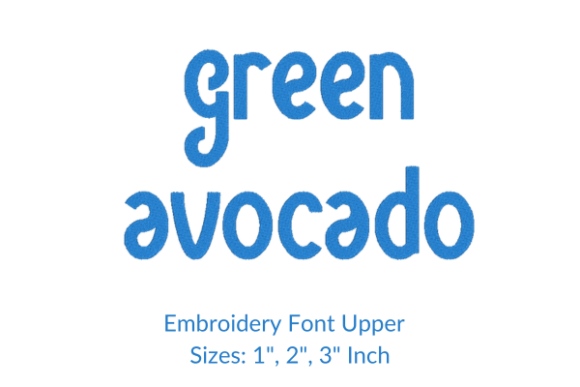
The Green Avocado Font Embroidery Design immediately reads as friendly and intentional—not generic, not overly technical, and certainly not sterile. It carries subtle rounded edges, gentle weight variation, and a relaxed rhythm that evokes hand-lettering without sacrificing stitch stability. That’s critical: many “hand-drawn” fonts collapse under thread tension or lose legibility at small sizes. This one feels designed *for* fabric—not just on screen. For a small business owner choosing between dozens of embroidery files, that nuance builds instant trust. It signals care, craft, and brand cohesion before a single stitch is made.
Real-World Performance Across Merch Channels
In my test runs across common small business applications, the Green Avocado Font Embroidery Design held up impressively:
- Embroidered patches: Works beautifully at 2"–3" height. Letterforms retain clarity even with satin-stitched outlines—no bleeding or distortion on twill or felt backings.
- Staff uniforms & aprons: Excellent for chest logos or sleeve accents. Its medium weight avoids looking thin on cotton duck or canvas, yet doesn’t overwhelm lightweight linen blends.
- Cap embroidery: Performs well on structured front panels when scaled to 1.75" width. Avoid ultra-narrow curved bill areas unless letter count is minimal (e.g., “Bloom” vs. “Bloom & Petal Co.”).
- Tote bag design & product packaging accents: Adds warmth to minimalist branding—especially effective alongside simple icons or botanical motifs. Stands out on natural canvas without shouting.
- Custom apparel for Etsy sellers & craft businesses: Enhances perceived value of handmade products. Customers consistently associate this style with artisan quality—not mass production.
It also integrates cleanly into broader design systems. When paired with clean sans-serifs for legal text or minimalist line art for logos, the Green Avocado Font Embroidery Design becomes the “human voice” in your visual hierarchy—perfect for names, dates, short quotes, or location tags (“Est. 2021”, “Portland Grown”, “Hand-Poured Daily”).
Where to Use It Thoughtfully
No font—even a well-digitized one—is universally bulletproof. Here’s where I recommend extra diligence with the Green Avocado Font Embroidery Design:
- Small patch sizes under 1.5": Test spacing and inner curves—some letters (like “a”, “e”, or “o”) may need slight manual adjustment to prevent fill collapse.
- Curved surfaces (e.g., cap bills, curved pockets): Always use appropriate stretch stabilizer and verify hoop placement aligns with grain. The font’s softness can exaggerate distortion if hooping is off.
- Dark uniforms or textured fabric: Confirm thread color contrast. Green thread on charcoal twill reads rich and premium—but pale mint may vanish. Run a black-and-white test first to assess value separation.
- Frequent-wash items (e.g., staff aprons, reusable totes): Review stitch density. Overly dense fills increase wear risk; lighter fills with balanced underlay hold up better long-term.
How It Shapes Brand Identity & Customer Trust
This isn’t just about aesthetics—it’s about perception. The Green Avocado Font Embroidery Design subtly communicates values: sustainability (avocado = earthy, nourishing), craftsmanship (organic flow, not rigid geometry), and accessibility (friendly weight, open counters). For a school-related application—say, a garden club patch or eco-curriculum tote—it reinforces mission alignment without needing explanatory text. For a bakery or florist, it elevates everyday items into branded keepsakes customers photograph and share. That drives recognition, repeat engagement, and word-of-mouth credibility—especially vital for small business merch competing against big-box uniform suppliers.
Essential Designer Notes Before You Stitch
Before committing to production—or offering this font to clients—here’s what every embroidery professional should verify:
- Test the Green Avocado Font Embroidery Design in black and white first to assess contrast and spacing integrity.
- Check minimum viable size: Does it stay legible at your smallest intended patch or cap application?
- Review thread color pairings against your fabric swatches—not just on screen.
- Inspect kerning and tracking, especially for custom names or short phrases. Auto-spacing rarely matches fabric behavior.
- Confirm hoop size compatibility with your primary machines—and whether nested versions exist for multi-position work.
- Always embroider a physical sample on your target fabric with correct stabilizer. Digital mockups lie; thread tension doesn’t.
- Create a printable mockup for client approval—showing scale, placement, and thread match—before digitizing full batches.
- Compare it beside your existing design assets. Does it harmonize with your logo, icon set, and other typography—or create visual dissonance?
- Verify commercial licensing. Since this is positioned for small business merch and branded patch use, confirm you’re cleared for resale, client projects, and digital embroidery file distribution—if applicable.
Remember: the Green Avocado Font Embroidery Design is a tool—not a shortcut. Its strength lies in how thoughtfully it’s applied. Used with intention, it transforms basic apparel into brand touchpoints. Used hastily, it risks looking like an afterthought. For schools, studios, cafés, and craft-based brands building identity stitch by stitch, it’s less about “green” and “avocado”—and more about grounding your message in something real, warm, and unmistakably yours.